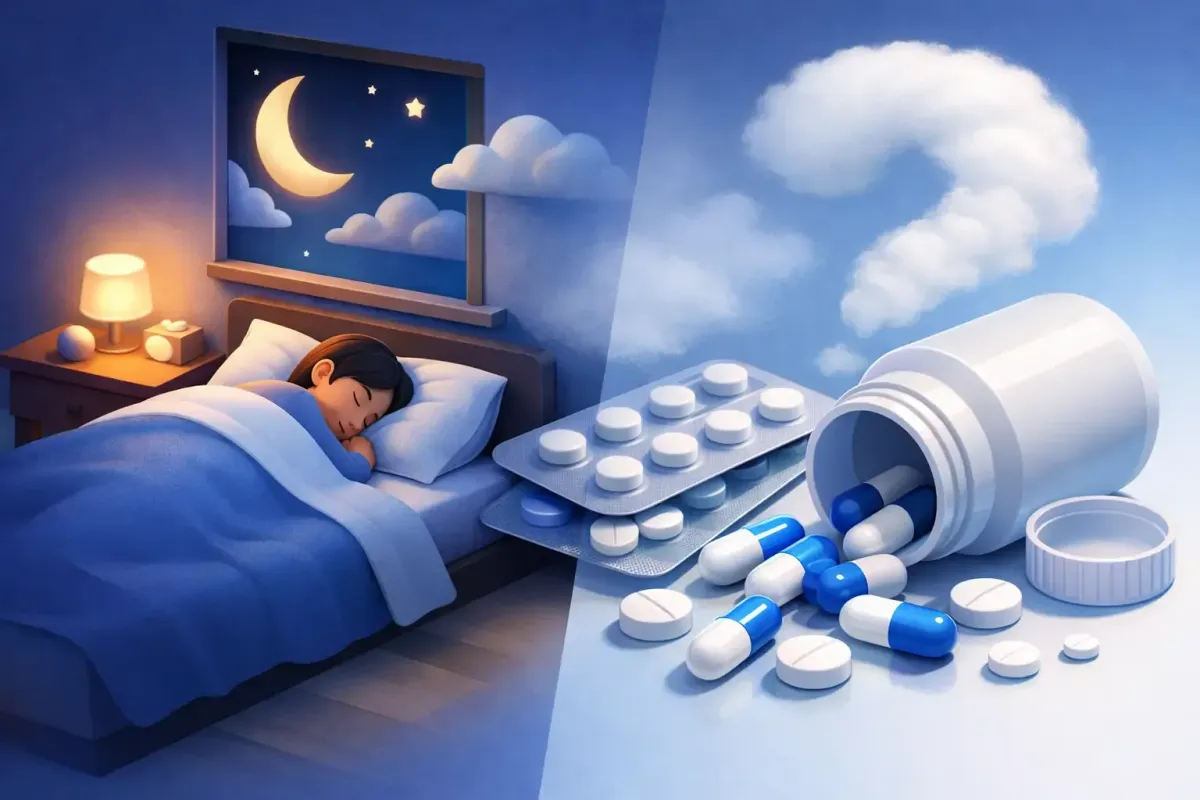
Can’t Sleep Without Pills? Read This
You go to bed already negotiating with yourself. Maybe tonight you’ll try without it. Maybe you’ll cut the dose. Maybe you’re just exhausted enough to finally sleep on your own. But if you can’t sleep without pills, you already know what usually happens next - the clock gets louder, your mind gets busier, and sleep starts to feel farther away.
That pattern can be deeply frustrating, especially if you’re someone who handles a lot well. You’re capable, responsible, and probably used to solving problems. So when something as basic as sleep starts to feel dependent on a pill, it can make you feel vulnerable in a way you don’t like. It can also leave you wondering whether the real problem is insomnia, anxiety, stress, or simply a body that has forgotten how to settle down naturally.
The truth is, needing help with sleep doesn’t mean you’re weak, broken, or doing life badly. It usually means your system has learned a pattern. And learned patterns can be changed.
When you can’t sleep without pills, it’s rarely just about sleep
For some people, sleep medication began during a difficult season - grief, divorce, burnout, health issues, perimenopause, work pressure, or a stretch of 3 a.m. wake-ups that became unbearable. At first, the pill felt like relief. It gave you a way to stop fighting the night.
But over time, the mind can start linking sleep with outside help instead of inner ability. That’s where the struggle often shifts. It’s no longer only, “Will I sleep tonight?” It becomes, “Can I sleep without this?”
That question carries a lot of emotional weight. If you’ve had even a few bad nights trying to go without medication, your brain may now treat bedtime as a test. The body responds fast to that kind of pressure. Heart rate rises. Muscles stay alert. Thoughts speed up. You become more watchful, not less. And watchfulness is the opposite of sleep.
So yes, the pill may be part of the pattern. But often the deeper issue is the conditioned stress response around sleep itself.
Why smart, high-functioning adults get stuck here
People who are successful during the day often struggle more with sleep than they expect. Not because they’re incapable, but because the traits that help you perform can work against rest.
You may be used to pushing through, staying mentally switched on, solving problems quickly, and holding yourself to a high standard. That works beautifully in business, leadership, parenting, and performance. It does not work well when your nervous system needs surrender, safety, and softness.
If your mind has become trained to monitor, predict, and prepare, bedtime can turn into a subtle control battle. You try to make sleep happen. Then you notice it’s not happening. Then you try harder. That effort creates tension, and tension delays sleep.
This is one reason sleep advice can feel insulting when you’ve already tried everything. Better sleep hygiene matters, of course. A cool room, less screen time, less caffeine, a more consistent schedule - these can help. But if your subconscious has learned that bed is where pressure, frustration, and fear show up, the problem won’t be solved by lavender spray and a stricter nighttime routine.
The hidden loop behind “can’t sleep without pills”
Most sleep dependence has a loop to it.
First, you have a bad night or a hard season. Then you use something that helps. Relief makes sense, so the behavior repeats. After that, your brain starts assigning safety to the pill and uncertainty to sleep without it. Eventually, even thinking about not taking it can create anxiety.
That doesn’t mean the medication is bad or that you’ve done anything wrong. It means your nervous system is doing what nervous systems do - it learns by association.
And once that loop is in place, logic alone may not break it. You can know you’re tired. You can know you’ve slept before without help. You can know stressing won’t help. Yet your body still responds as if bedtime is risky. That’s why so many capable people feel confused by insomnia. Their conscious mind understands one thing, while their subconscious programming runs another.
What actually helps when pills have become part of the routine
If you’re dealing with this, it helps to think in terms of retraining rather than forcing. Your goal is not to prove something at 11 p.m. Your goal is to help your mind and body relearn sleep as a safe, natural process.
That usually starts with removing some of the emotional charge around the problem. Sleep gets easier when it stops feeling like a nightly performance review. The less drama attached to the process, the more room your body has to do what it already knows how to do.
It also helps to address the layer underneath the sleep issue. Sometimes that’s stress. Sometimes it’s anticipatory anxiety. Sometimes it’s unresolved emotional overload that only becomes loud when the day goes quiet. And sometimes it’s simply the subconscious belief, “I can’t sleep on my own anymore.”
That belief matters. Because if your system accepts it as true, your body will act accordingly.
Can hypnosis help if you can’t sleep without pills?
In many cases, yes. Especially when the problem isn’t just a lack of information, but a deeply repeated response.
Hypnosis works differently than willpower. It doesn’t ask you to fight your mind harder. It helps calm the internal pattern that keeps reactivating at night. For someone who can’t sleep without pills, that can be a meaningful shift. Instead of trying to talk yourself into sleep while your body stays braced, hypnosis helps create a more receptive state where the subconscious can begin accepting a new experience.
That might include reducing bedtime anxiety, quieting mental overactivity, restoring a sense of safety at night, and weakening the automatic link between sleep and medication. It can also help with the pressure-driven habits that often fuel insomnia in high achievers - overthinking, internal urgency, perfectionism, and the sense that you always have to stay mentally on.
This is one reason people who’ve already tried apps, supplements, routines, and self-help often respond well to hypnosis. They don’t need more advice. They need help where the pattern actually lives.
A skilled, credentialed hypnotist is not guessing. The work is structured, personalized, and focused on the root of what keeps the cycle going. At Sharon Jackman Hypnosis, that means looking beyond the symptom of poor sleep and helping you change the subconscious response that has made nights feel harder than they should.
What change can look like
It’s usually not about one dramatic night where everything is instantly perfect. Sometimes change begins more quietly. You notice less dread at bedtime. Your mind doesn’t spin up as quickly. You wake in the night but don’t panic. You feel more trust in your body. Sleep starts becoming something you allow instead of something you chase.
That matters more than people realize.
Because once the fear around not sleeping begins to loosen, the whole pattern can start to shift. Your system no longer needs to stay on guard. And when the body feels safe, rest becomes possible again.
There can be practical decisions along the way, and those should be handled thoughtfully. If medication is involved, changes to use should always be approached responsibly and in coordination with your prescribing medical provider. This isn’t about throwing away support. It’s about creating deeper support so you’re not relying on one tool alone.
You are not failing at sleep
If you’ve been telling yourself, “I can’t sleep without pills,” try hearing it differently. Not as a permanent truth, but as a description of a current pattern. Patterns feel powerful when you’re in them. They are not the same thing as destiny.
Your mind and body can learn a new response. You can become someone who feels calmer at night, who trusts sleep more, and who doesn’t carry the same fear into bed. That change doesn’t have to come from trying harder. Often, it comes from working at the level where the problem was learned in the first place.
If sleep has become a private struggle you’re tired of managing alone, that makes sense. And if part of you is ready for a different approach, that makes sense too. Sometimes the next step isn’t more discipline. It’s finally getting the right kind of help for the pattern underneath it all.